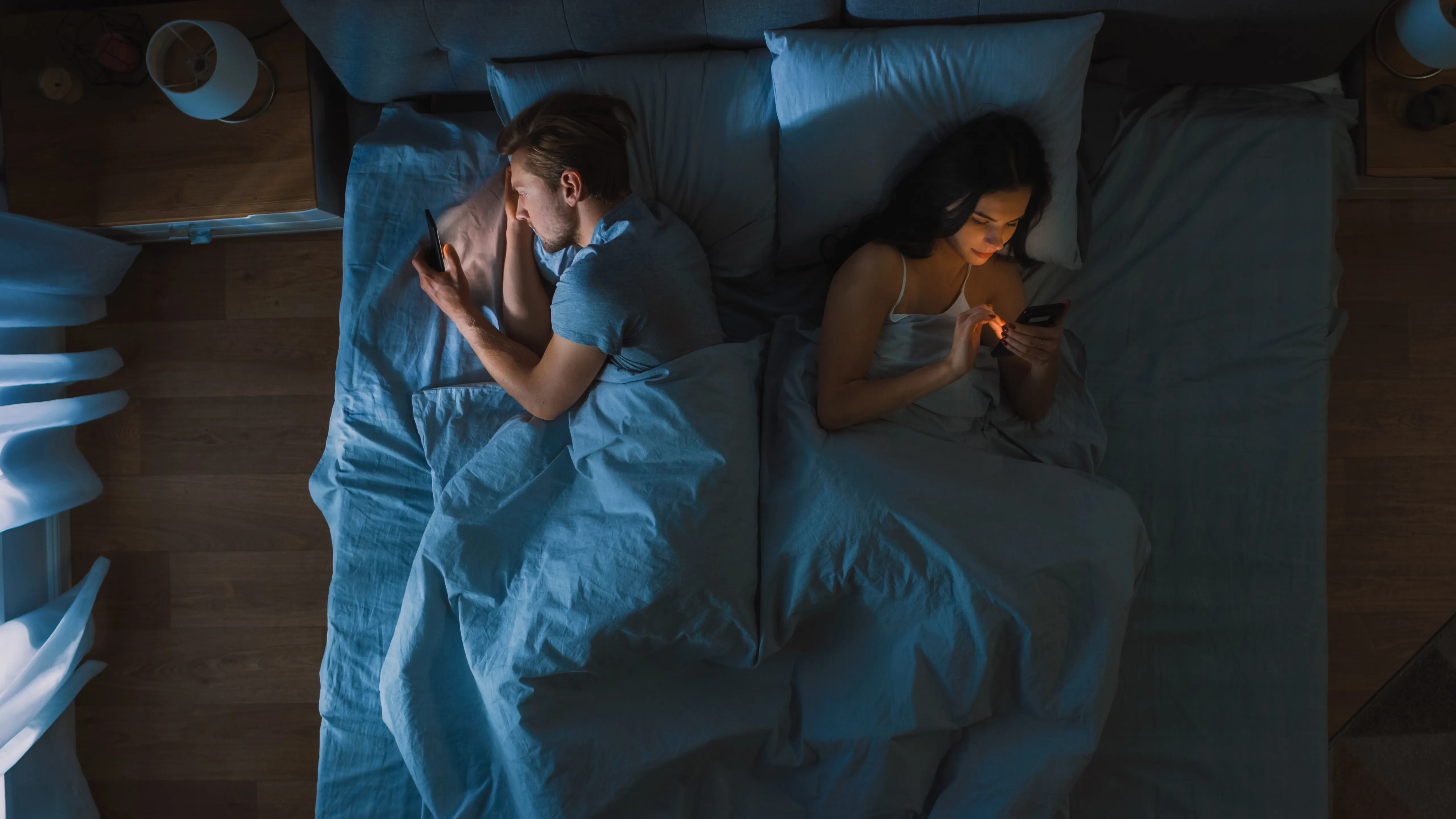
If you’ve ever stayed up scrolling and then felt strangely flat, irritable, or “off” the next morning, it’s tempting to blame willpower, dopamine, or “blue light” as a single culprit.
The reality is more layered. The best-supported explanation isn’t one magic mechanism—it’s a chain reaction:
- screens keep you awake later than you intended,
- that pushes your sleep timing later (circadian misalignment),
- sleep becomes shorter and/or lower quality,
- your brain starts the next day with less emotional regulation capacity.
A newer theme in circadian neuroscience is that mood is tightly linked to _when_ you sleep, not only _how much_ you sleep. When your behavior repeatedly drifts later than your internal clock (or your work/school schedule), the mismatch shows up as worse mental health outcomes in population data.
What newer sleep research is pointing to
A large Stanford-led study (reported by Stanford Medicine in 2024) used data from nearly 75,000 adults and found that “night owl” chronotypes had better mental health when they _didn’t_ lean into late-night behavior—specifically when they went to sleep earlier than their natural preference.
That’s an important reframing:
- It’s not just “being a night owl” that relates to mental health.
- It’s the _behavior_ of staying up late (and the downstream mismatch with daytime obligations) that seems to matter.
This dovetails with what many people experience with late-night screens: the device isn’t only emitting light—it’s enabling a pattern (late timing, delayed sleep onset, shortened sleep) that’s hard for your biology to absorb without consequences.
A grounded mechanism: circadian delay + less recovery
There are three well-supported pathways that can connect late-night screen use to next-day mood.
1) Circadian misalignment (sleep timing shifts later)
Light in the evening—especially bright, close-up light—can signal “it’s still daytime” to the brain’s clock. Even when total sleep time looks okay on paper, later timing can collide with early wake demands, leading to a chronic “social jet lag” feeling.
2) Sleep loss or sleep fragmentation (more awakenings, lighter sleep)
When screens push bedtime later, sleep often gets squeezed. And when sleep is shortened, the brain’s emotion-regulation systems tend to be less stable the next day.
Evidence that bedtime screen exposure is linked to insomnia risk comes up in recent reporting: one summary linked an hour of screen time at bedtime with a substantially higher insomnia risk, based on observational research.
3) Cognitive and emotional arousal (content matters)
Not all screen time is equal. A calm, familiar show isn’t the same as conflict-heavy social media, gaming, work email, or doomscrolling. Arousing content can keep stress systems “online,” making it harder to downshift into sleep.
Sleep education resources increasingly describe this as a combined effect of light exposure, time displacement (staying up later), and stimulation.
Where the “dopamine depletion” idea fits—and where it doesn’t
It’s common to hear that late-night scrolling “depletes dopamine,” leading to a bad mood the next morning.
Here’s the honest version:
- Plausible interpretation: highly stimulating, novelty-driven content can leave you feeling mentally “jangled,” and poor sleep can reduce motivation and positive affect the next day. People often interpret that drop as a “dopamine crash.”
- What we can’t confidently claim from these sources: a precise, proven dopamine-depletion mechanism in humans that directly explains next-morning mood after nighttime screen use.
So, it’s safer to say: late-night screens can increase stimulation and delay sleep, and _sleep/circadian disruption is a well-established pathway to worse next-day mood_. The “dopamine” framing may describe subjective experience, but it’s not the strongest evidence-based explanation on its own.
The evidence is not perfectly one-sided
An important nuance: not every study finds that bedtime screen use is uniformly harmful.
A Toronto Metropolitan University news release (about a cross-Canada survey of 1000+ adults) reported that overall sleep health looked similar for people who used screens nightly versus not at all, and that patterns were complicated (some groups reported better timing or alertness).
This doesn’t mean screens are “good for sleep.” It means:
- effects may depend on _who you are_ (baseline insomnia, anxiety, chronotype),
- _what you do_ (content type),
- _how you use it_ (brightness, distance, duration),
- and _what it replaces_ (sleep vs quiet wind-down).
In other words: the harm isn’t guaranteed, but the risk rises when screens reliably shift you later or rev you up.
A simple way to think about next-morning mood
If your mood feels worse after late-night screens, ask two questions:
- Did my screen use change my bedtime or sleep duration?
If yes, mood effects can be “just sleep,” and that’s already a big deal.
- Did it change my sleep timing relative to my wake time?
Even with enough hours, later timing can create a circadian mismatch—especially if you still have to wake early.
That combination—shorter sleep + later sleep—tends to produce the next-day state people describe as: lower patience, lower positivity, more emotional reactivity, and a kind of thin mental fuel.
What to take away (without turning it into a moral rule)
- Late-night screens are often a _timing problem_ more than a “screens are poison” problem.
- The strongest, most consistent link to next-day mood is through sleep disruption and circadian misalignment.
- The “dopamine depletion” story may capture the felt sense of a mood drop, but the best-supported levers are still: when you fall asleep, how long you sleep, and how wound-up you are before bed.
Sources
- https://med.stanford.edu/news/all-news/2024/05/night-owl-behavior-could-hurt-mental-health--sleep-study-finds.html
- https://sleepeducation.org/screen-time-and-sleep-what-new-studies-reveal/
- https://www.healthline.com/health-news/screen-time-bedtime-insomnia-risk
- https://www.sleepfoundation.org/bedroom-environment/technology-in-the-bedroom
- https://www.torontomu.ca/media/releases/2025/11/using-your-phone-every-night-before-bed--researchers-say-that-s-/