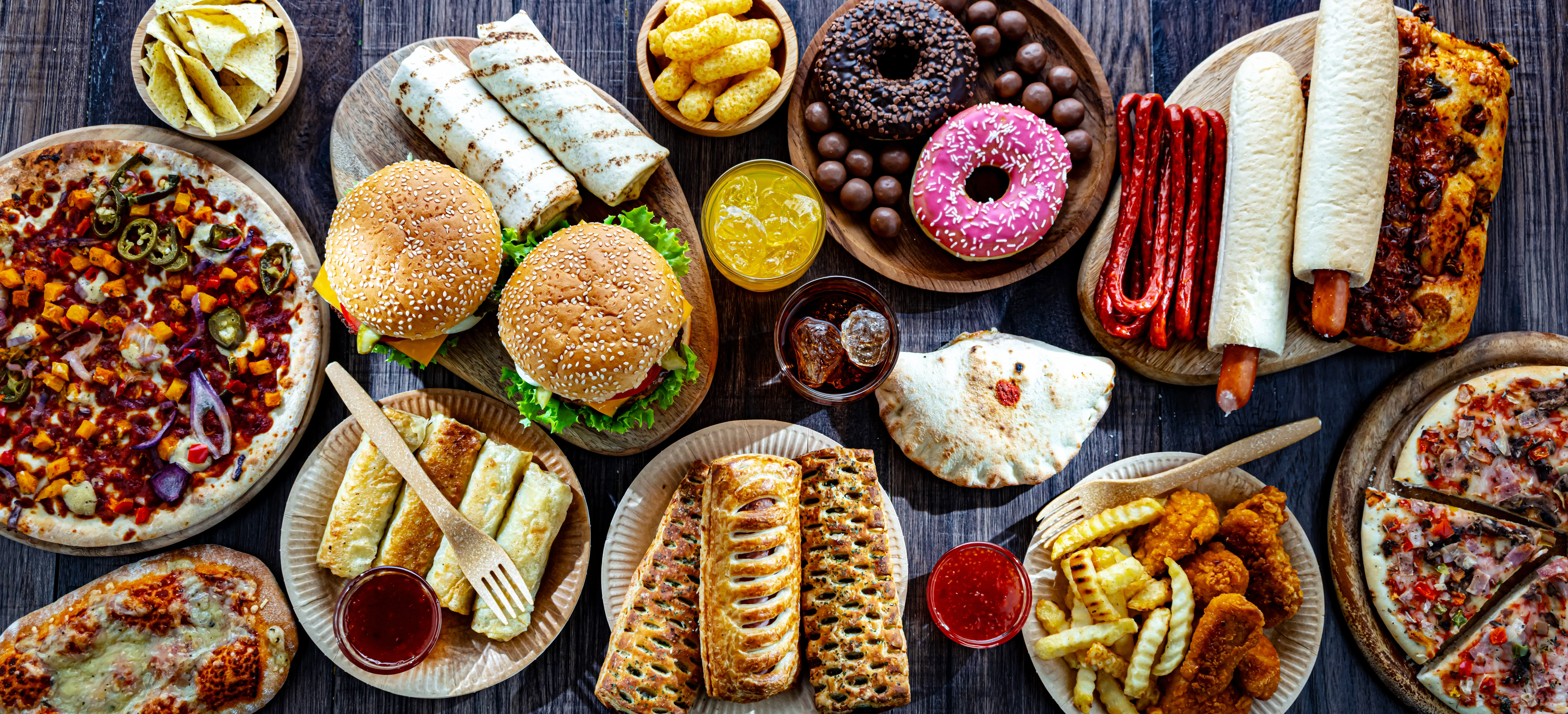
That “~60% of calories” figure is a shorthand for how dominant ultra-processed foods (UPFs) are in the U.S. food environment.
A useful way to read it is: in an average day, the majority of calories many Americans eat come from packaged, industrially formulated products (often designed to be convenient, shelf-stable, and highly palatable), rather than from minimally processed foods.
Two important caveats:
- This is a population average. Intake varies a lot by age, income, and dietary pattern. Some people are far below 60%; others are substantially above it.
- “Ultra-processed” is a classification (commonly the NOVA system). It’s not a single nutrient or ingredient, and the category is broad—ranging from sugary drinks and candy to some packaged breads, cereals, and ready-to-eat meals. That makes the number informative at a societal level, but imperfect for judging any single food.
Why it tends to matter (what research suggests): higher UPF intake has been associated in prospective cohort studies with higher risk of several adverse outcomes, and experimental work suggests UPFs can increase energy intake in ways that promote weight gain. These links don’t prove every UPF causes harm on its own, but they do support the idea that a diet dominated by UPFs is often a marker—and potentially a driver—of poorer overall diet quality.
Sources
- https://www.fau.edu/newsdesk/articles/ultra-processed-foods-inflammation.php
- https://publichealth.jhu.edu/2024/ultraprocessed-foods-account-for-more-than-half-of-calories-consumed-at-home
- https://pmc.ncbi.nlm.nih.gov/articles/PMC5787353/
- https://www.sciencedirect.com/science/article/pii/S2161831323013820
- https://www.thelancet.com/series-do/ultra-processed-food